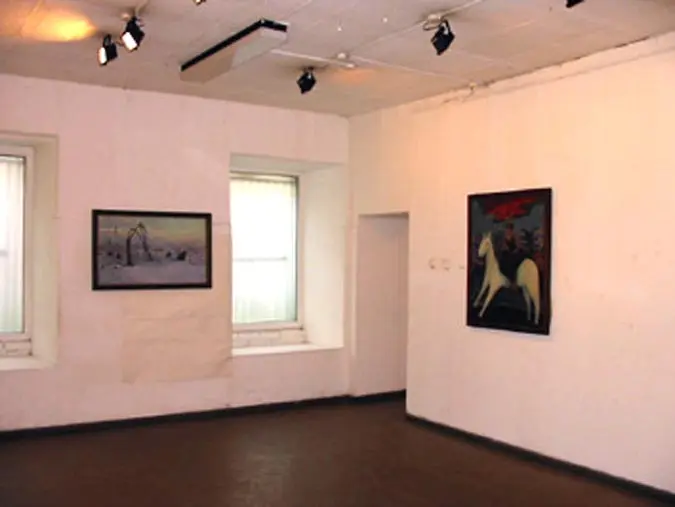
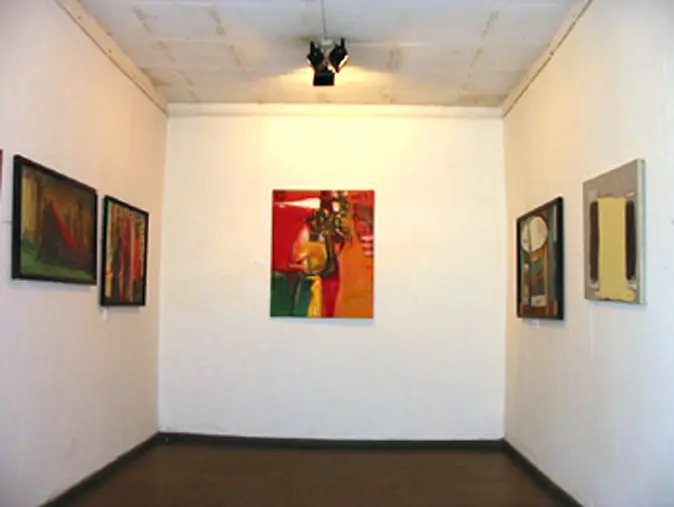
    | | | Created for the support of Petersburg artists, in the course of time the Gallery became a rather prestigious spot for organization of exhibitions both of domestic and foreign artists. We believe that in the situation when there are few exhibition spaces in the city and a great scale of creative ideas, aesthetic concepts and artistic practices, the main actual task is to present as many artists as possible independent on genre and technology. Exhibitions in the Borey Gallery are in the non-stop regime. It is a basic principle of the Gallery to support beginning artists and creators (the first exhibition, the first book, the first article). Absence of aesthetic snobbery and restraints in the interests of a special group of artists. Accessibility and openness.
|
|
|
March 22 – April 2 2011. Tiina Vainio. Paintings, graphics. |
TIINA VAINIO
«GREENHOUSE, WEEDS»
paintings / graphics
In the small hall | 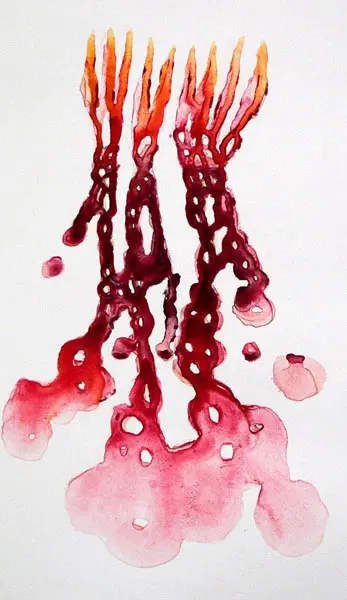 | | 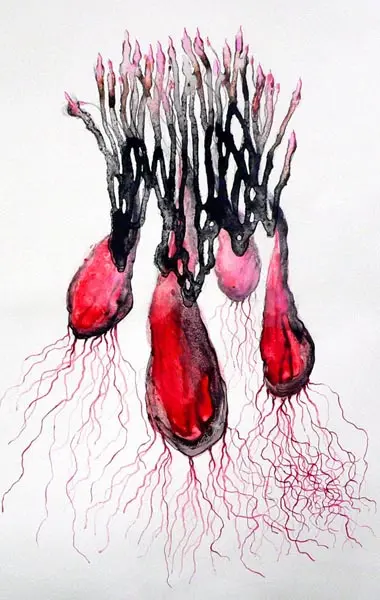 | | 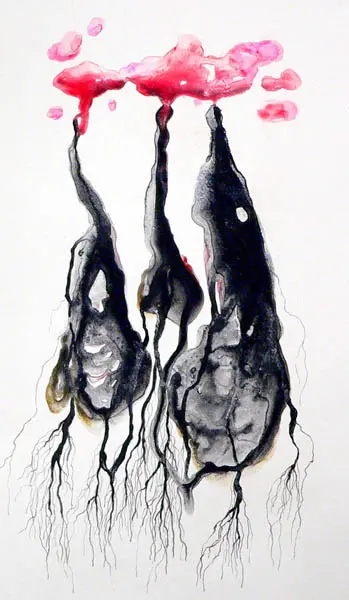 | | | | | | | Tiina Vainio is a visual artist from Turku, Finland, whose work with art is quite versatile. In addition to installations and exhibitions, her artistic work includes set design, community art and park planning and design.
She often treats materials in a humoristic and experimenting way. E.g. rag rugs, army towels and sail cloths all have their own story to tell in her art.
The exhibition at the Borey Art Gallery is called Greenhouse and the theme of the exhibition is weeds. Her exhibition presents graphic drafts on sicilian graph paper – she has prepared them in Tuscany, Italy, with the theme of local weeds. In life it often goes so that little things, first regarded as insignificant, end up becoming revolutionary – both in a good and a bad way.
In addition, the exhibition displays a series of paintings of thickets and burdocks, created on Swedish army surplus linen towels. War and battles are like clinging burs of a burdoc, often leaving behind a desire to revenge.
|
|
|
|
March 8-19, 2011. PARAZIT Creative Association |
«Internal MILITIA» from "PARAZIT" Creative Association
Painting / graphics / objects
In gallery halls"PARAZIT" Creative Association:
Yuri Nikiforov, Vladimir Kozin, Dmitry Petukhov, Igor Panin,
Semyon Motolyanets, Igor Lebedev, “Mylo” (Soap) group,
Ivan Tuzov, Alexander Shishkin-Khokusai, Ilya Zelenetsky,
Vladimir Lilo, Julia Sopina, Tatiana Krylova, Ivan Osipov | | | 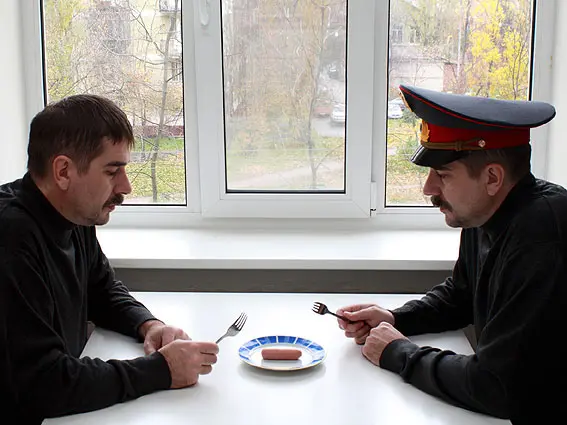
|  | | |
| 
| 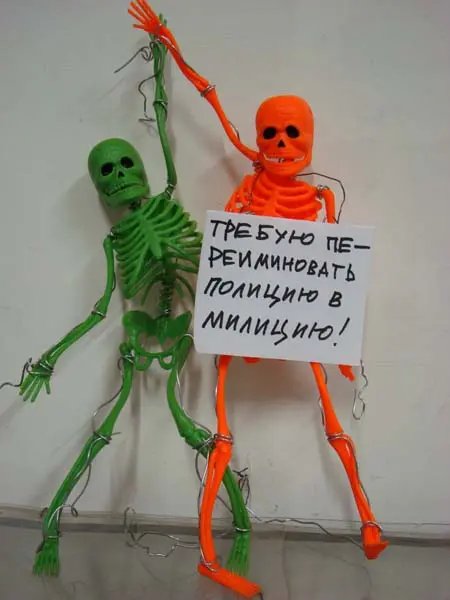
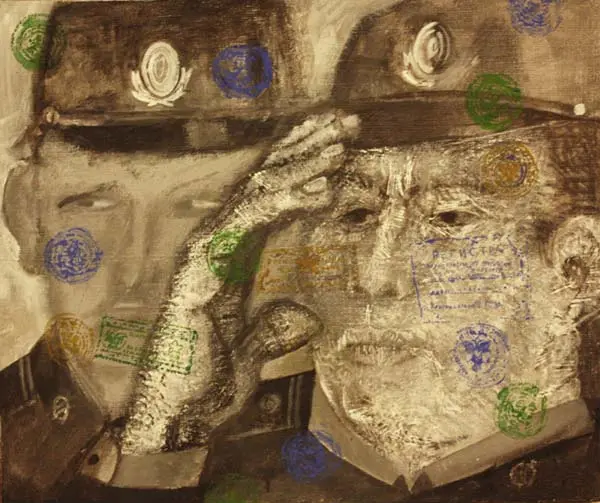
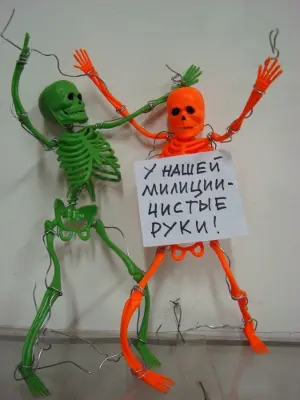
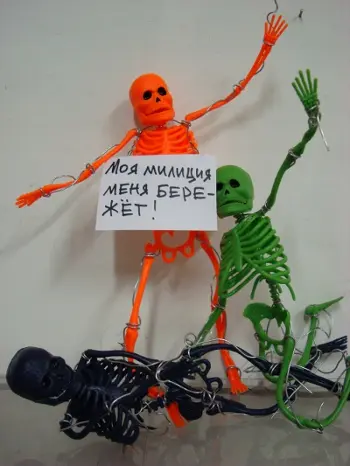
| 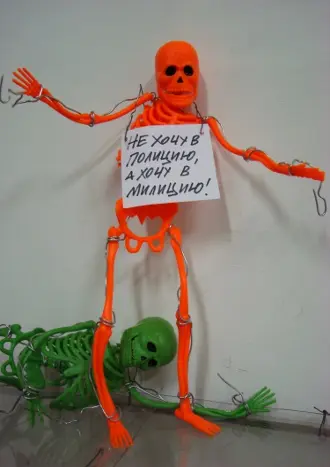 | | | Internal MILITIA In a grey, grey town, on a grey, grey street, in a grey, grey house there lives a grey, grey man. His coat is also grey, as well as the country which he serves. But many people think (and others are deluded) that this very grey man is to blame for everything dishonest in this country. They found a “figure” for revenge, and we could also share this opinion, as there are enough reasons for this revenge. An eye for an eye. And it’s impossible to break this vicious circle. Militia turned into a caste, which makes each of its members match the common idea. And in for a penny, in for a pound. Under the oppression of vox populi it’s too hard to overcome social conformity. There is no good militiaman, because there isn’t even an image of him. And even if there is one, it’s simply not convenient to accept it, as there is such a ready-made convenient and concise image of the bad militia. And it’s more important for us how we remember disappearing militia than what’s the difference between it and the new police. We’re not militia’s barristers (there are reasons to reproach them, however today only the lazy haven’t cursed them, this position having become real commonplace), we rather see the problem of generalization and global depersonalized objectivity. Recently there’s even appeared a couple of antagonists: a modern artist --- against --- a militiaman. Where one of the most important criteria for an artist’s existence is to be brought to a militia department and to be prosecuted. Interesting to know, is this modern artist really better than this militiaman? And what can he offer but for his revolt? Men in uniform are out of favor. And what about exceptions: “a sensitive militiaman”, Uncle Styopa, a figure of Ostap Ibragimovitch in a Kiev militiaman’s cap, and militiamen-painters, militiamen-bards, a militiaman-the-butter-fingers, who lost his service gun – what shall we do with them? Also smear them with a generalized grey curse “cops are garbage”? The image of internal enemy has overlapped the depth of an existing phenomenon to such an extent that has left no space for a paradox, non-conformism and exception from the rules. But the history feeds on exceptions from the rules. A new notion of law is being formed, and this law is intuitive and defined almost personally for everyone. And at the same time there is extremism originating from the mask of art, and it will surely bear fruit. Is it possible to find today a better intonation with which to say goodbye to the word “militia”? "PARAZIT" Creative Association makes an exhibition “Internal MILITIA” to find an alternative view on militia institution, which doesn’t claim factual accuracy and reality of what’s going on. Aggression and irritation in one’s attitude towards “militia” will be the best tools to objectively render historical atmosphere in the beginning of the XXI century’s second decade, but should we erase details and other possible interpretations of this phenomenon, yielding to universal revenge hysteria, for the sake of historical logic? |
|
|
|
March 8-19, 2011. Svetlana Druzhkova. Painting. |
«SOUNDS AND PAINTS»
Painting
In the small hall | 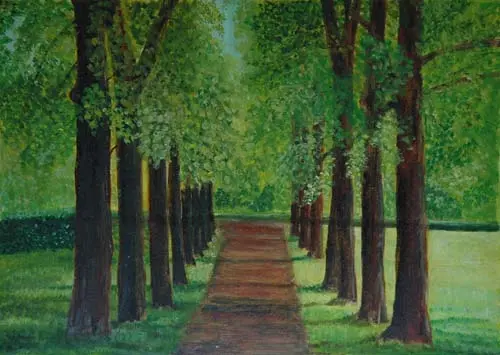 | | 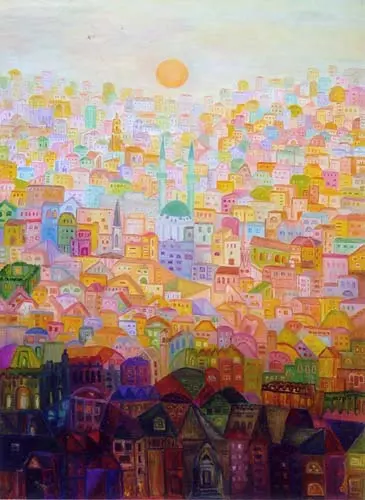 | | 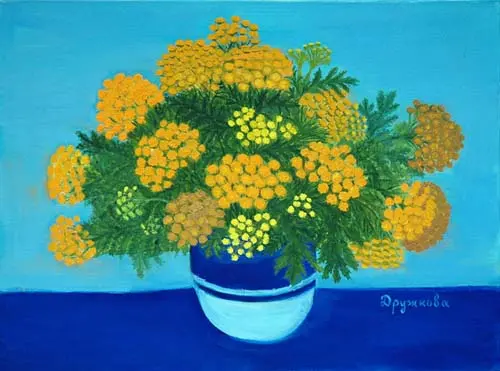 | | | | | | | Svetlana Druzhkova was born in Leninabad in evacuation in 1945. She spent her childhood and youth in the Urals, where she began to practice music and to give lessons.
Since 1997 she’s been living in St Petersburg, and still continues to teach the piano.
In 2001-2004 she took a course of studies at Contrast studio school under supervision of V.B.Shragi.
Member of Arts Union association since 2005.
Participant of international exhibitions in Turkey in 2005-2008, in Finland in 2004, 2008, 2009, in Israel in 2007, 2009, in Germany in 2008, 2009, 2010.
S.Druzhkova’s works are in private collections in Moscow, St Petersburg, Turkey, Israel.
From 2001 till 2011 she had more than forty collective and solo shows.
Solo shows:
2005 – Solo show “Petersburg Rhapsody” at Borey gallery (St Petersburg)
2006 – Solo show “Flower Symphony” at Central District Library named after Sobolev (St Petersburg)
2007-2009 – Baer-Sheva, Dimona, Yeruham (Israel)
2008 - “Divertimento” at Borey gallery (St Petersburg)
2008 – “Sunlight”, Centre of culture “Planeta” (St Petersburg)
2009 - Koln (Germany)
2010 – Kondase Centre, Viljandi (Estonia)
2010 – “Music of Paints”, “Gertsena 6” gallery (Pskov)
SOUND AND PAINTS There are two components coming forth in Svetlana Druzhkova’s painting. The first is love for color, colorful texture, which complies with her so womanly emotional, sensual perception of life and to the maximum extent is expressed in her numerous still lives.
Despite the fact that classes in an art studio preceded independent work, her flowers, fruits, cockerels, fishes and other nature creations put into a cozy space of small canvases are usually deprived of proper accuracy typical of class works. They attract with something different: heart-stirring and richly composed bunches of great variety of flowers, some kind of childish composition simplicity, urge to make the whole image stay on view, which is characteristic of naïve artists. Finally, objects and flowers are perceived not like what they are, but like the author’s appeals to the observer. We can say that these are “messages” of kindness, which make you feel calm and bright.
Svetlana’s life before she started to paint (it happened about ten years ago) and up to now has been connected with music, which defined the other component of her painting. Notional color forms which build up such compositions in Druzhkova’s works are partially abstract and include ornamental elements. They all are involved into some kind of motion and build rhythmical reechoing colors, lines, forms which seem to start producing sounds ("Galaxy" 2007, "Garden City" 2008).
St Petersburg’s architectural image, which the professional piano player adapted in her own manner, influenced her painting greatly. Exquisitely decorated and rhythmically organized facades of buildings, used as backgrounds for some still-lives at times gain similarity with piano keys ("Trio" 2006). In a program work “I love you, Peter’s creation” a magnificent white palace against the background of a huge red apple is perceived as a solemnly sounding organ.
Svetlana Druzhkova looks at the world with a kind smile. The diversity of artistic impressions which influence her doesn’t interfere with rendering in color the light and harmony rising from the bottom of her heart.
Natalia Saltan, Art Critic
|
|
|
| | << Start < Prev 1 2 3 4 5 6 7 8 9 10 Next > End >>
| | Results 46 - 54 of 245 |
|
 gallery