home  gallery October 1 - 19, 2013. Valery Valran. Painting. gallery October 1 - 19, 2013. Valery Valran. Painting.
|
|
October 1 - 19, 2013. Valery Valran. Painting. |
LEVITATION
Painting
In the small hall | 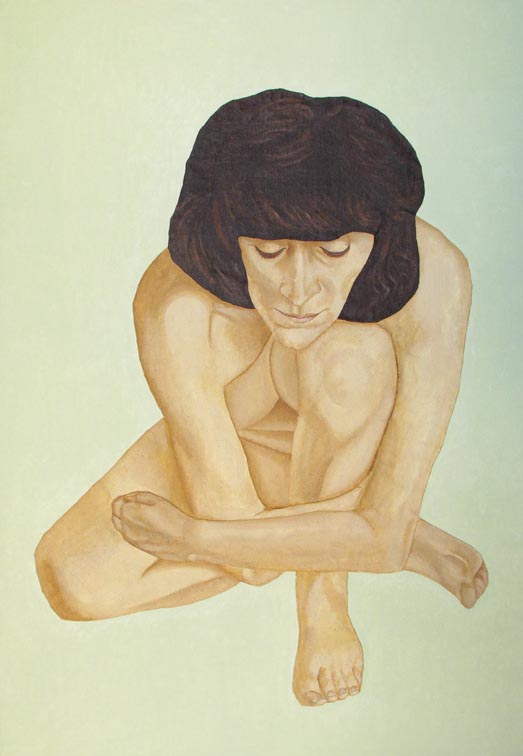
|  |  | | | VALERY VALRAN
He was born on the 27th of August 1949 on the Izhma Station in Ukhtinsky Region of the Komi ASSR. Until 17, he had lived in Pechora city of the Komi ASSR. In 1966 he enrolled in the Leningrad Pedagogical Institute, the Mathematical Department. 1967 – 1972: Department of Psychology of the Leningrad University. 1975 – 1979: postgraduate studies at the USSR Academy of Pedagogical Sciences. In 1980 he defended a Ph.D. thesis in psychology.
He has been involved with painting since 1972. His first works were fulfilled in the expressive abstractionism manner, under the influence of J.Pollack and E.Mikhnov-Voitenko. Since 1975: still life, compositions of objects. Since 1979: landscapes, mainly the city views. 1981 - 1985: portrait. Since 1987 he has started developing stylistics of the "archetypal still life". Since 1982: a "magical abstractionism". In spite of his efforts made in different trends, three lines have always been predominant: the abstractionism, still life, city scenery.
He has been taking part in exhibitions since 1976: first at unofficial "apartment" exhibitions, and since 1979 – in exhibition halls and galleries. He took part in over 100 group exhibitions in Russia, Germany, Switzerland, USA, England. 42 personal exhibition.
His works are kept at the State Russian Museum (St.Petersburg), The State Museum of the St.Petersburg History, at the Non-Conformist Art Museum (St.Petersburg), National Gallery of the Komi Republic (Syktyvkar), Museum «Remerhall» (Germany), Museum of Modern Russian Art, Jersey City (USA), Tver Regional Picture Gallery, The State Yaroslavl Art Museum, The State Arkhangelsk Art Museum, Anna Akhmatova Museum in the Fontanny Dom (St.Petersburg), The A.S.Popov Central Museum of Communications (St.Petersburg), Museum of Modern Art “Erart” (St.Petersburg). |
Phantoms of Levitation
Gleb Ershov
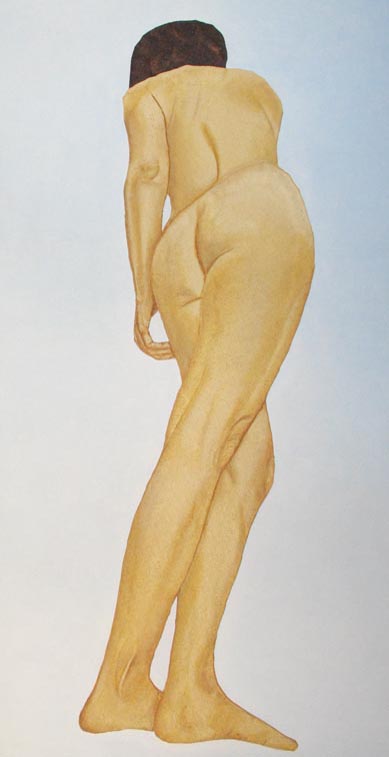
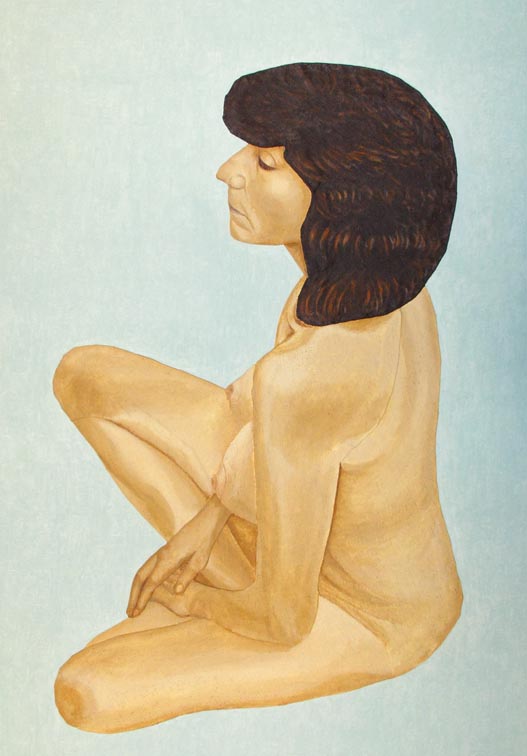
Eleven big canvases put together in groups surround spectators like painted walls of a secluded chapel: all over the walls there are naked women’s figures in the state of levitation. A lot of figures but the woman is the same, in different states and viewpoints, as if the artist is turning his model, trying various poses on her like a kind of “social” clothes which somehow label her this or that way. As nobody else Valran possesses the ability of depicting objects and figures ? whether they are bottles, sprats, spheres, squares or women ? in vacuum, where there is no gravitation. His forms seem strange: he removes them from their usual surroundings mercilessly, defining the picture’s boundaries by accurate cut. Deprived their habitual environment the objects and bodies seem dried up, “sun-cured” a little like those big fishes that used to appear in the canvases by this artist who prefers cutting edges, folded forms and absence of shadows. They seem spectral beings, phantoms existing separately, images pulled out from the stream of our memories, not related to any history. These dream images fade just after their recalling. You feel keenly this incorporeity, illusiveness, colourlessness and, at the same time, rudeness of physical intimacy of these by no means suprematist figures of planetary remoteness. As always, Valran’s works are “still-lifely”, “texturous” down to the limit, he is the artist of foreground big details. And here too, the bagging and bass texture, perforated, fleecy surface comes out in the foreground, so well matching by contrast with the bodies built on subtraction of flesh and physics. Our eye inevitably feels violence when meets obstacles put by the texture of cellular flesh itself. The artist plays on the contradiction between the detachment of levitating figures, their disconnection from reality and utmost proximity when an onlooker literally has his nose in the canvas. Just then the feeling of utmost nakedness or, namely, strippedness, defenselessness and outright shamelessness, when the temptation of cloaking disappears and the body is ready for dissection. But is the spectator ready himself? Here by your own eye you touch the body able to arouse your desire and erotic temptation. But something different is experienced here too ? your perception channel switches, and, of course, you could say that it is the dead flesh, capsule, cocoon though it’s not exactly so. These figures with ochreous colouring, having no shadows, where all the worldly is overcome and man’s spiritual essence participate in eternity much easier to imagine in icons. “Personal” here is transferred into figures turned into relics ? it’s a bit strange from the physics point of view ? into flesh that in Christianity became vivid evidence of immortality. May be such an effect is produced by this connection of “gothic” spirituality with the turning over of signs banal for contemporary art? Lucian Freud portraying a human body as a piece of flesh looking at us in the prime of life insisted that his figures should be perceived from the nearest view of them. Bloodless and suspended in the space without coordinates Valran’s figures are supplemented with one more very important detail ? actually in all the canvas the woman’s eyes are closed or her face is turned aside which does not suggest a dialogue with a spectator playing part of a wingside onlooker. But this is not Giorgione’s “Sleeping Venus” where the author’s admiring is pure and chaste. The works are related to Freud’s by their “still-lifeness” though the bodies in “Levitation” are represented not as whole objects but are created from several fragments. The author uses special technique: the figures are cut piecemeal and stuck on the canvas like collage. They are literally cut off and sewn together from several pieces of… not bagging but leather forming folds and bumps. Leather folds and canvas ones differ and sometimes put over each other making a permanent shift from the raised cloth objectness to illusiveness of the represented form. Your eye after all is doomed to travelling around the woman’s body, to permanent touching it and its appropriation. The artist seem wishing to get rid of the masculine view representing the naked woman’s body just like that to possibly eliminate all the clichés of perception. (Tsarevitch Ivan burnt down the Vasilisa the Wise’s frog skin hoping to find not a frog but a beauty, though he achieved nothing). The woman here is being liberated, “disrobed” from certain notions that we provide her with to obtain the other ones. The only thing you can benefit from this experiment of switching off our perception channels one by one is that even in the state of meditation and levitation, absolute loss of weight and prostration, a woman is still the strongest gravitation origin, like it or not. | | | THE ART OF THE GREAT INCOMPATIBILITY
Alexander Sekatsky
Valran is the artist who’s chosen several subjects of work for himself and dedicated them all his life, that is, his creative life. Such a choice becomes reasonable and worthy only when the task is unsolvable, when it goes beyond the bounds of artistic project and breaks through into metaphysical dimension. Any word order inevitably becomes flat (for all its possible grace) if it does not enter into a conflict with the nature’s order itself and, similarly, any clear figurativeness able to produce autonomous magic effects if it does not dare to break through into the sphere of inexpressible, remains within its one-dimensionality of visual pleasure. Naturally, it is not the matter of illustrations to some philosophic ideas but of inner artistic gesture, displaying some cinema of redundant dimension, like the Mobius band capturing contraband amount of space (or, poetry, according to Mandelshtam, is like “stolen air”) ? this band should be inconceivably curved once more to seize the pulsation of sense in addition to illegitimate space, remaining at the same time on one’s own modest ground, for example, in the canvas. Such is the Valery Valran’s road: he practices incompatibility, aerobatics of subtraction-abstracting necessary for a flight range, when you have to drop down the stages of gravitation one by one as they work off. The artist himself has found out quite suitable term for it ? levitation; in European philosophic tradition from the Aristotles times the term hypostasis is used due to which our most important nouns, kind of “sladost’ ” [sweet] and “skorost’ “ [speed] are formed. There is no embodied speed in the physical world, there is only “something fast”, but for breaking through into the world of meanings anything fast or even the fastest doesn’t do, it is just speed that you need here and then it meets with the “lightness”, for instance, or “penetrability” or “perspicacity” and, as a result of these meetings, secondary, newly acquired sense loads appear. Valery fulfils these actions by the most difficult artistic means.
One can remember some previous experiences of radical withdrawal having been realized by the artist: these are domestic articles withdrawn from their usual and apparently irrevocable surroundings, simply pulled out into nowhere; Petersburg landscapes abstracted from their own habitability; space sketches still (or newly) deprived of their own expansions ? continuity, homogeneity, suitability for localization of objects among them. Each time you see expositions of heightened strangeness or, in other words, artistic discoveries, for example, an object’s hyperrealism which cannot be reproduced by “simple photographic image”. And now again Valery Valran returns to eroticism, to Eros, with his extraterrestrial manner to perform a decisive and one of the most difficult, of course, experiment of an artistic “hypostasis”. It’s true, a woman’s body is a universal erotic object having its many latent representations practically in all the strata of figurativeness. One can depict a hose curve so that it becomes a manifestation of sexuality. Visualization of a naked woman’s body, or more precisely, its “strange visibility” occurs in landscapes, still-lives and in abstract compositions and that’s not the point of any preoccupation here, it’s a matter of art influence in general, one of its constituents: temptation works regardless of its sublimation degree, so the artist, who wants to capture his spectator, feels hard not to use this weapon… But Valran resolves the contrary task, he carries out an experiment of withdrawing a woman’s body from the concomitant aura of temptation, performs a peculiar vivisection or “raschlenionka” [dismembering] ? separation of a woman’s body from the body of womanliness and you can’t know the result beforehand. As physicists say, the negative result is still the result, and besides, it often does an experimenter the honour. The compulsory distillation reveals quite interesting things. Let’s recall Tarkovsky’s poetry:
…you were sleeping,
And to touch your eyelids by the blue of the universe The lilac stretched out from the table.
An artist is able to catch eyelids touched by the blue and thus to depict the lilac not seeing any lilac at all. In this sense in Valran’s works the residual erotic “strange visibility” is present ? it appears, such are the results of this experiment. There are also the remains of some cultural contexts, for example, of the art history, but these “enstranged” [«die Verfremdung»] methods of presence bewitch you in their turn. The effect of incompatibility is achieved ? as if among improving each other attempts of comprehension, the gesture of radical senselessness went off confirming that everything remaining, not having fallen off, is indeed sound.
|
|
|
|