Vladimir Yashke is a bright and flamboyant figure of St Petersburg art scene, known as “Mitki’s granddad”. Possessing a lambent and natural talent in painting and rare working efficiency, he created many hundreds of paintings, which are eye-catching, distinguished, absolutely individual and easily recognizable. Many know him like this. But there’s another Yashke staying in the shadow of Yashke-the artist, less familiar to a wide audience, but not less bright and original. It’s Yashke-the graphic artist. The show presents this side of his talent.
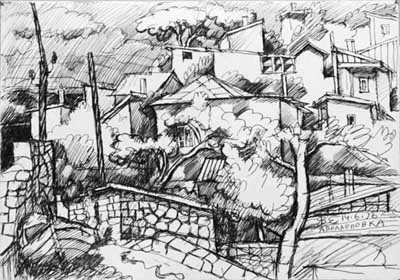
There are thousands of drawings in Yashke’s artistic heritage. He draws non-stop, like he does almost everything else. You can hardly imagine such a variety of themes, techniques used by a modern artist. He always draws a lot. With anything and on anything. From a full-size plotting page to a scrap of cigarette box. If he didn’t manage to finish it on the list, he would piece out something else, even of a different sort, texture and tone. There is nothing which is unpleasant or difficult for him to draw with. Only pencil is rare enough. He prefers something tougher, more distinct: a pen-point, cane, a ball-point. There are crayons, felt-tip pens, and moreover, in various combinations.
In landscape sketches he prefers to restrict himself to a slightly tight formula. Rigid fixation of composition, main themes, spatial relations. And there are plenty of such drawings. Using them you can trace the story of his trips to the Crimea, to the Caucasus, to Old Ladoga. The Crimea from Sevastopol to Yalta, both near-shore and mountainous, is sketched hundred times. There is also quite a number of St Petersburg views.
A separate Yashke’s passion in drawing is ink. He draws both with a pen-point and a brush. The drawings are living, playing with contrasting white and black spots. Probably these works are the most impulsive and spontaneous. They’re hasty and expressive.
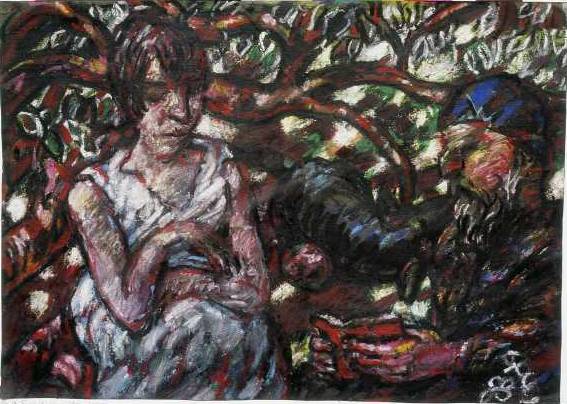
There are a lot of color objects in Yashke’s graphics, but water color and gouache in his works often move somewhere outside graphics. The formats are large, the paint is loaded thickly, pastously. Water colors are painted in a wide manner, quickly, but often is processed afterwards with a pen-point and with white.
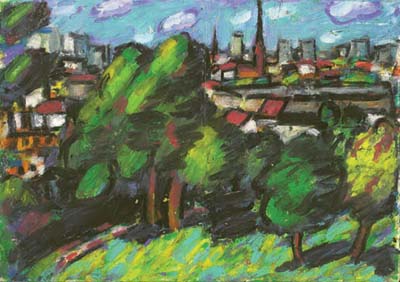
Oil pastel also interferes with painting. Yashke’s works are often overloaded in Van Gogh’s manner with technicolor, dense, “tasty” paint, keeping its rich relief texture. The same can be said about his pastels.
And there’s also mass-market graphics: copperplate print on linoleum and dry point etching, as well as monotyping and stencil screen printing. This sphere of graphic art organizers decided to leave for next time show.
At the exhibition opening, which is planned for October 5, at 17:00, there will be a presentation of Vladimir Yashke’s book “Berlin Diary 1994”, reproducing the diary kept by Yashke in May-June of 1994, while he was in Berlin. In this publication touching, sincere childhood and adolescence reminiscences, amusing and interesting thoughts about art, na?ve narration of everything happening to the author and his feelings are accompanied by magnificent drawings: Berlin views, scenes from the memories, sketches from nature, drafts of future works and so on. These little masterpieces are generously scattered on the diary’s pages. The diary’s text is supplied with comments, which explain to the reader Berlin life realities of those years, and possibly decipher these and those well-known or little-known persons hiding behind initials and names. The book was published in 200 pieces, each of which is signed by the author.
|