Alexander Sementzov (1941 - 2005) was born on May 17 1941 in Kerch.
1960 - 1966 – student at dpt of physics and mathematics of Tbilisi State University
1963 – 1965 - student at Art Academy in Tbilisi.
1965 -1967 - student at dpt of arts of Tbilisi State University.
Since 1976 - member of the Union of artists of Georgian SSR.
Since 1986 - member of the Union of artists of USSR
Many works by Sementzov are abroad, in particular in the town of Beskov (Brandenburg, Germany) where the artist has been living for the last decade. His triptych is in Marienkirche, the main cathedral of the town.
The biography of Alexander Sementzov could be a base for a fascinating plot: he was born in the Crimea, was evacuated to Georgia and stayed there. Though he had loved painting since his childhood, he decided to become a physicist, as many did in 1960-ies. Upon graduation from Tbilisi State University (1960-1966) he worked in experimental physics for 19 years, with painting as a hobby. In 1976 he becomes a member of the Union of artists of Georgia, and in 1986 – a member of the Union of artists of USSR; since 1993 he has been a member of the Union of artists of St. Petersburg.
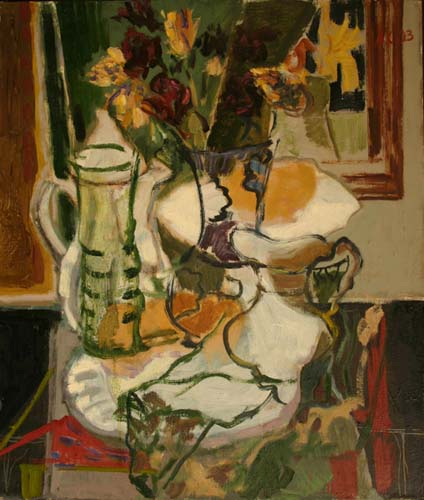
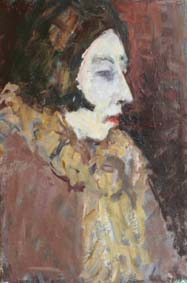
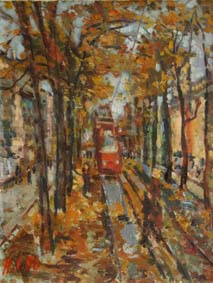
Alexander Sementzov is an artist with good art training (at Tbilisi Art Academy he was Vasily Shukhaev’s student). The roots for his style is the art of the late 19th - early 20th century, in his manner one can feel the influence of German expressionism, French post-impressionism, especially of Cézannes and Utrillo. The refined artistic mastership of Sementzov is combined with clear cut author’s position as of a Man of the World. The artist as a true philosopher realizing the imperfection of the reality, does not turn off his eye from the unfair and terrible. On his canvases there are not only beautiful cities, like Petersburg, Paris, Berlin, or flowers – but also lonely and confused people, the Sennaya square of 1990-ies with its stalls and ragged residents, senseless ruins of fratricidal conflicts of the last post-soviet decade…
"The works by Alexander Sementzov have many sides. Lovers of fine art know his wonderful lyric landscapes and still lives, which keep attracting your sight again and again. But this exhibition shows us another Sementzov, a severe and strict artist. Like Virgil he takes us through the three circles of the Russian hell. He shows us the essence of the world we would never like to see and would like to forget and never know. It is civic Sementzov, who has built, with his brave palette, a unique philosophy of post-Soviet Russia – its historical philosophy in colours.
Sementzov’s urban theme at first sight resembles his lyric urban landscapes. But if you watch attentively, you get captured by involuntary anxiety. These thrilling impressionist strokes create inner tension. What courage one should have to live in a modern city with dignity, to remember of the eternal, to remain in the state of high serenity amongst hourly rebellion (“Bridge: Help me, oh Lord!”)
The city calls for sacrifice. Any person is a fragile flower, but the city crumples and cripples flowers. The artist likes the city dwellers, admires then, but he suffers and takes pains over their petty corruptibility and feverish cheerfulness, gets ill with their lies. Nice faces – and suddenly savage mugs peeping out…
Russian countryside… What is hidden by city lights, sets forth with awesome clearness. We find ourselves in the second circle of the Russian hell. The dying, the ruined and the unable to make any ends meet. Here it is, rural Russia being raped, with her bosom naked and her mouth tied. And a thug towering over it. And a child watching it all with his eyes tied.
The third circle of the Russian hell is the war, which implacably (and already commonplace!) goes today. But we, city dwellers, see the war only on TV screens and confuse it with action movies. Sementzov has looked into the eyes of this war and endured its glare – the glare of Gorgon.
The artist has fulfilled his civil duty if he has managed to show us what we, in our laziness, cowardice and falsity, have no guts to look at.
He has made us braver, stronger and more truthful.
Konstantin Pigrov |