Julia Sopina was born in Leningrad in 1968. In 1987 she graduated from Leningrad Art College named after Serov. Since 2004 - member of the St. Petersburg creative union of artists IFA. Lives and works in St. Petersburg.
"What people really need is Silence. Where can one find high-quality Silence? Outside the city. Silence plus never-ending rains and absolutely no sun. This is how you learn to appreciate many things. Silence presses, and essences start coming to you."
J.Sopina
"Moi qui de loin tendrement vous surveille
Let me start with an elucidation: by painting artists usually mean certain style rather than a kind of fine art. That is, the pictorial one. A brief and proper definition of this style would read: something that makes a picture live and connects it with the artist's soul strings.
Ekaterina Andreeva likes starting her articles like this: when I was a small girl... Not literally but something of the kind. So, when I was a small girl there was a popular slogan saying Life always gives room for a feat. That's true. Doing painting in the 2000s was almost as heroic as being a non-official artist under the Soviet regime. If you doubt that just come to the Petersburg exhibition at Manege. There are two floors stuffed with some paintings. But just try to find there something really vivid and done by a younger artist. That would be a difficult search even if you are lucky to find one.
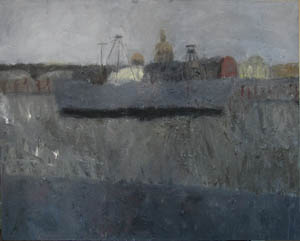
Yulia Sopina started doing painting in the above defined sense in the 2000s. Before that she handled it as a kind of fine art and, in my view, she was brilliant in that. Those were decorative and stylized works. Perfectly harmonious. Had they been wall paintings, they would fit a palace. Sometimes they reminded of a tapestry: dull colours, coziness, dim ornament where heaven is artificial and crystal dew is asleep. A dumb and contingent glimmering world couched in slumber. A lace of petrified shapes. Domination of light blue colours betrayed the influence of Sterligov's school or, rather, serene Zubkov's school. You could see how an intellectually and artistically devoted movement became emasculated and turned into salon art. Yes, Sopina's painting was of salon type, though brilliantly made. Still one could feel something powerful hiding in that dozy world. And it did spring out.
Suddenly there was motion instead of confusion. Relentless risk instead of careful construction.
Beauty, as Proust puts it, is a regulated conformity. The more elements a picture has and the more controversial they are, the harder it is to have them conformed. To create a harmony with a few dim coulours is one thing; to work with plenty of them, different by brightness and saturation, to work with risky colour combinations, to put a dazzling stain on a mat background and still not to kill the whole work-is a different thing. Using a usual device is one thing, search for a new technique to apply to a new motif is a different thing. In the latter case you are at risk of failure. Yulia's pictures sometimes fail to endure an austere look. At times it is only a piece of picture that you really like. Still as a whole a picture is a delight. It's a live face that, even if it lacks beauty, is still better that the formally faultless but the lifeless one.
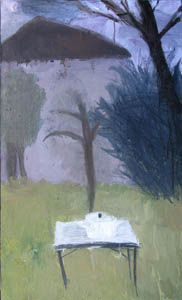
Yulia started making pictures inhabited by live matters: bushes, benches, grand piano legs. You can feel the scent, damp air, air flows.
How did she manage to achieve such a rare directness and immediacy and dispose of stringency and artificiality?
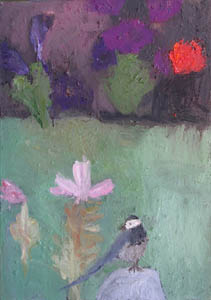
First and foremost, she turned to reality. To landscape and man in landscape. And to other live creatures: birds, cats. Becoming deeper involved into the world.
Talking of associations, I would name Bonnard, his delightful charisma, humour, unconstraint, outsight, interest for accidents. Talking of contemporary St. Petersburg art, I would mention V. Sotnikov, A. Semichev in his early period, and A. Sinstein with his large bright stains and perception of life as a festival. And through jolly and light Sinstein I discern the formal studies of sombre Solomon Rossin whom Yulia even might not know. What makes her radically different from Sinstein and at the same time closer to Rossin is literature. Many artists perceive the presence of literature in painting as a deadly sin.
Still, St. Petersburg artists - including the best ones - indulge in literature. They are capable of constructing narratives without sacrificing artistic values. However, that won't be a verbose literature: it's not a story, it's a situation of a man, his condition, his relations. If I try to define the type of this literature I would say: a line of poetry.
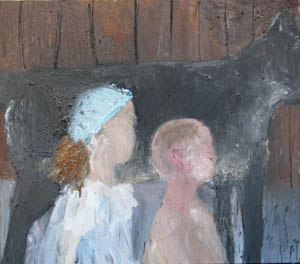
Yulia has her own poetics. She does not use someone else's motifs and she does not invent her own ones. Rather, she sees them. Here is quite a popular motif, the beach. It is usually rendered as a general view with many figures. On Yulia's paintings, you find a close view of an insignificant event: one picture shows a child stooping over his mother's spread body that seems to have turned into a dead one and the child has no idea how to react. On the other work you only see the mother's legs, something unbelievably huge from the child's point of view. They hinder from viewers some large construction - perhaps, a tower that the child is building with his spade. The artist has a good understanding of the children's world, she regularly paints them. Children are her primary concern also in the scenes that are entirely hers - in religious ceremonies, in scenes from the life centered around Catholic church. Boys helping a priest. Boys holding candles. Children's mass. The ball of the Sunday school graduates. Processions, choir. For Yulia, these scenes are the oasis of purity. Religious motifs that seem to be a losing game in contemporary painting is managed here with greatest innocence.
In llya Kabakov's long description of his installation The Winged Fly, there is an essay On Emptiness in which Kabakov writes about his fundamental feeling that shapes all his experience. This is the feeling of 'the emptiness of the place where we all permanently live" - the hole in space, the tear in the texture of being. One of its attributes is total absence of interaction between the inhabitants of these holes. Apart from a few close ones, they are all hostile, dangerous or at best indifferent. The aliens are the carriers of this emptiness. I do not know whether this text reflects Kabakov's mind-play or his real experience of life but when you encounter the works of Moscow conceptual school emptiness is the first feeling you get. If the world is empty, you can not feel pity for it.
What llya Kabakov says is not true. Should you think your own experience is scarce, look at Yulia Sopina's paintings. Yulia perceives this world as inhabited by strangers whom she watches 'tenderly from a distance'. The world talks to her and prompts her response. What is valuable is this responsiveness, this diversity of motifs and inexhaustibility of objects that resonate with the artist's feeling.
It is impossible to lie in painting. Painting is directly opposite to simulation. Given the current state of things when truth and lie, life and play are enjoying equal rights, this seems to be the greatest value possible".
Lyubov Gurevich |